


.png)
Dwelling approvals fall in May
The Australian Bureau of Statistics (ABS) reported on 01.07.26, that the total number of approved dwellings decreased by 1.1 per cent in May, reaching 17,019, according to seasonally adjusted data.
Daniel Rossi, head of construction statistics at the ABS, stated: 'The decline in total approved dwellings was primarily due to a 10.4 per cent drop in private dwellings excluding houses, following a 4.0 per cent increase in April.'
'Approvals for private sector houses increased by 2.8 per cent, reaching their highest level since September 2021. This marks the fourth consecutive month with over 10,000 private sector houses approved.'
Year-on-year, the total number of approved dwellings is 5.3 per cent higher.

Western Australia and New South Wales Propel Private Sector House Increase
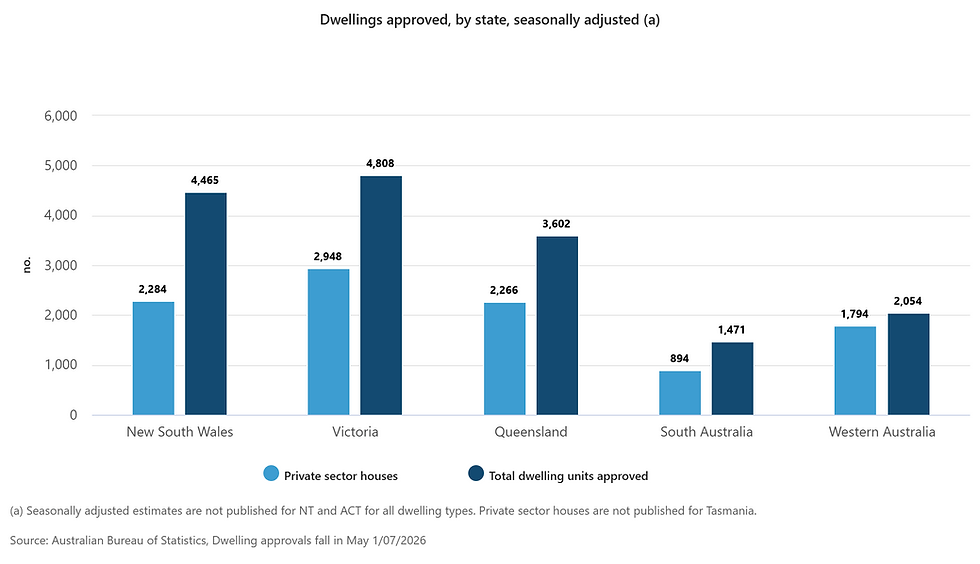
Private sector house approvals rose by 2.8 percent, reaching 10,537 dwellings. The May figures are 13.2 percent higher compared to the same time last year.
'Western Australia maintained strong growth in detached housing approvals, increasing by 9.9 percent, and is up 24.5 percent compared to May 2025,' Mr. Rossi stated.
'New South Wales saw a 7.8 percent rise in May, marking the fourth consecutive month with over 2,000 approved private houses. This result is 24.1 percent higher than a year ago.'
'Conversely, private sector house approvals in Queensland decreased by 3.6 percent, following its highest result since July 2021 last month.'
Decline in Apartment Approvals in May
Private sector dwellings excluding houses dropped by 10.4 percent to 6,034 dwellings. The May figures are 8.6 percent lower year-on-year.
In original terms, apartment approvals decreased by 30.0 percent to 2,877 dwellings, which is 29.3 percent below the average of the previous twelve months (4,070 dwellings).
Data Centre Approvals Boost Value Increase
The total value of building approvals climbed 13.6 percent, reaching a record $21.07 billion, following a 7.9 percent increase in April.
Non-residential building approvals surged by 41.0 percent (to $10.83 billion), after a 22.9 percent rise in April. This marked a record high for non-residential buildings, driven by a rise in large data centre approvals in New South Wales and Victoria.
The total value of residential building decreased by 5.7 percent (to $10.24 billion), consisting of a 6.6 percent decline in new residential buildings (to $8.88 billion) and a 0.1 percent increase in alterations and additions (to $1.35 billion).
"Private sector dwellings excluding houses" includes semi-detached, row or terrace houses, townhouses and apartments.
Source: Australian Bureau of Statistics (1 July 2026), Dwelling approvals fall in May, ABS Website, accessed 14 July 2026.
Australian Bureau of Statistics. (2026, July 1). Dwelling approvals fall in May. ABS. https://www.abs.gov.au/media-centre/media-releases/dwelling-approvals-fall-may.


Comments